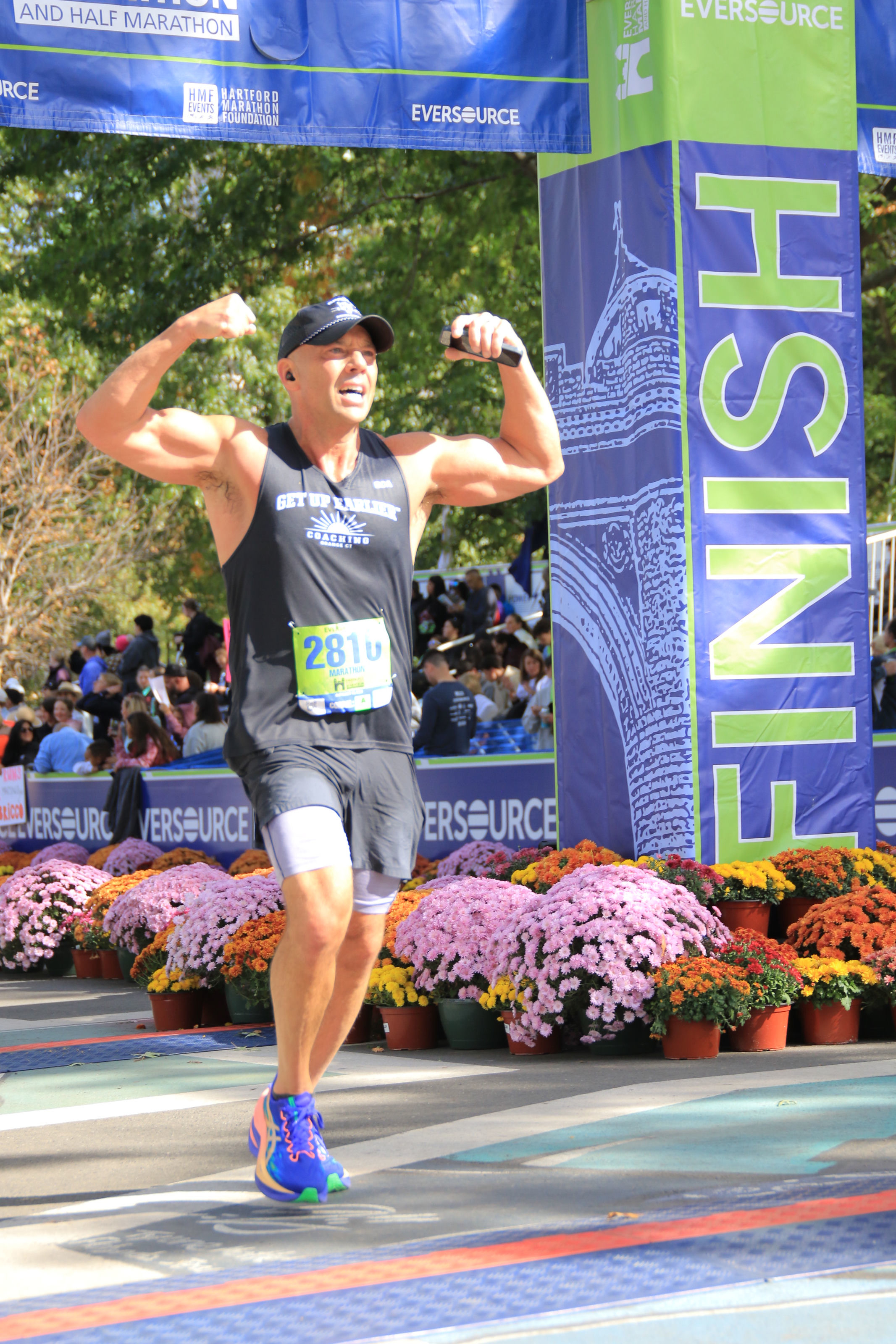
FROM 3:51 TO 3:18: THE BOSTON QUALIFYING PROJECT
I did it. I cracked the code and broke the barrier.
3 hours 18 minutes at the Hartford Marathon, averaging 7:34/mi. The Boston qualifying standard for my age group (50-54) is 3:20, about 7:38/mi, so technically and officially, I am now a Boston Qualifier.
There is a catch. Running the qualifying standard does not guarantee you a spot in Boston. Because there are so many fast runners now, simply hitting the qualifying standard isn't always enough. The most recent cutoff was 5 minutes and 17 seconds faster than the qualifying standard. Boston has also added a random selection of 1,000 additional runners who achieved their qualifying standard but missed the cutoff, so there is another potential path in.
But none of that changes what happened. I broke 3:20.
This project was about finding out whether I could become a runner capable of running a Boston qualifying time. I did.
THE PROGRESSION
It started with the NYC Marathon in 2024 at 3:51:44, averaging 8:51/mi. A year later I ran Hartford in 3:25:59, averaging 7:52/mi.
In March I ran the NYC Half in 1:31:27, averaging 6:59/mi, breaking the 1:32 time-qualifying standard, about 7:01/mi, for my age group. That performance earned me guaranteed time-qualified entry into both the 2027 NYC Half and 2027 NYC Marathon.
Then came Erie in September.
Erie was supposed to be the BQ attempt. I arrived fitter than I'd ever been, but heat and humidity took over the race around mile 16. I finished in 3:34, about 8:10/mi, recovered, and decided to take one more shot just 27 days later.
Back to Hartford.
3:18 at 7:34/mi. New marathon PR. More than 33 minutes faster than my first official marathon less than two years ago, more than 7 minutes faster than Hartford one year ago, and finally under 3:20.
I DID A LOT OF THIS MY OWN WAY
I also did a lot of this my own way.
I have severely flat feet. I don't train by heart rate or obsess over running metrics. I don't use a Garmin. My entire running tech stack is my phone, Strava and headphones. I replaced traditional gels with a homemade mix of honey, maple syrup and sea salt, along with dates.
I continued lifting heavy throughout the build instead of giving up strength to become a runner. I ran only three days a week for most of the program, with intervals, hills and very long Saturday runs.
Some of it was unconventional, but over time I learned what worked for my body.
WHAT IT TOOK
Along the way there were thousands of training miles, 5 AM runs, intervals, 20+ mile long runs, hills, heavy lifting, yoga, carb loading, homemade fuel, weather disasters, destroyed toenails, shoe experiments, work, kids, vacations and all the normal life that still has to happen while you're training for something like this.
I learned a lot. Getting to the start line really might be the hardest part of a marathon. Heat is still my kryptonite. Fueling matters. Pacing matters. And the final 6-8 miles expose exactly what still needs work.
Most importantly, I learned that at 51 years old, just weeks away from turning 52, I can still get significantly faster.
BOSTON QUALIFIER
The Boston Qualifying Project is complete.
Goal: sub-3:20 / 7:38 per mile. Result: 3:18 / 7:34 per mile. Boston Qualifier: YES.
Getting into Boston is another challenge.
The BQ standard was the barrier I wanted to break. I broke it.
WHAT'S NEXT
For now, marathon training is over. I'm going to get leaner, get stronger and get faster.
The next goals are 155 lbs, a sub-1:30 half marathon, which means breaking 6:52/mi, 19:XX in the 5K, which means breaking 6:26/mi, and strength beyond where I was before marathon training.
Then I'll take that version of myself into the 2027 NYC Marathon, which I've already earned my way into through the NYC Half time qualifier.
The NYC Marathon time-qualifying standard for my age group is 3:14, about 7:24/mi.
But I'm not aiming for 3:14.
PROJECT NYC 2027: 3:10
My new goal: 3:10 at the NYC Marathon in 2027. About 7:15/mi.
Lean. Strong. Fast.
The first goal was to become a Boston Qualifier.
Done. Now we get faster.